
Little Blonde Head: A Love Letter Across Centuries
How a golden tomato traveled through time, carried by the hands of gardeners who refused to let beauty fade
Whispers from the Old World
There are stories the earth remembers that no book records. There are origins lost to time, dissolved into the soil of centuries past, leaving only the faintest traces, such as a name, a seed, a memory passed from hand to hand in the quiet ritual of harvest.
Blondköpfchen is one such story.
Somewhere in the German-speaking heart of Europe, in the rolling hills of Germany, the alpine valleys of Austria, perhaps the pastoral gardens of Switzerland—a tomato emerged that glowed like captured sunlight. We cannot say precisely when. We cannot name the gardener who first held its golden fruit and whispered, little blonde head, with such tenderness that the name became inseparable from the plant itself.
What we know is this: it was the 19th century, or perhaps earlier. It was a time when gardens were not hobbies but lifelines, when saving seed was not nostalgia but necessity, when every tomato plant was chosen with the careful deliberation of someone who understood that next year’s harvest depended on this year’s choices.
The Gardeners Who Saw Gold
In Central Europe, heirloom gardening was an act of faith. It was the belief that some things were worth preserving. Worth the careful work of selecting the best fruits, drying the seeds, storing them through winter’s darkness, planting them again when spring returned.
Blondköpfchen was one of those worth-keeping things.
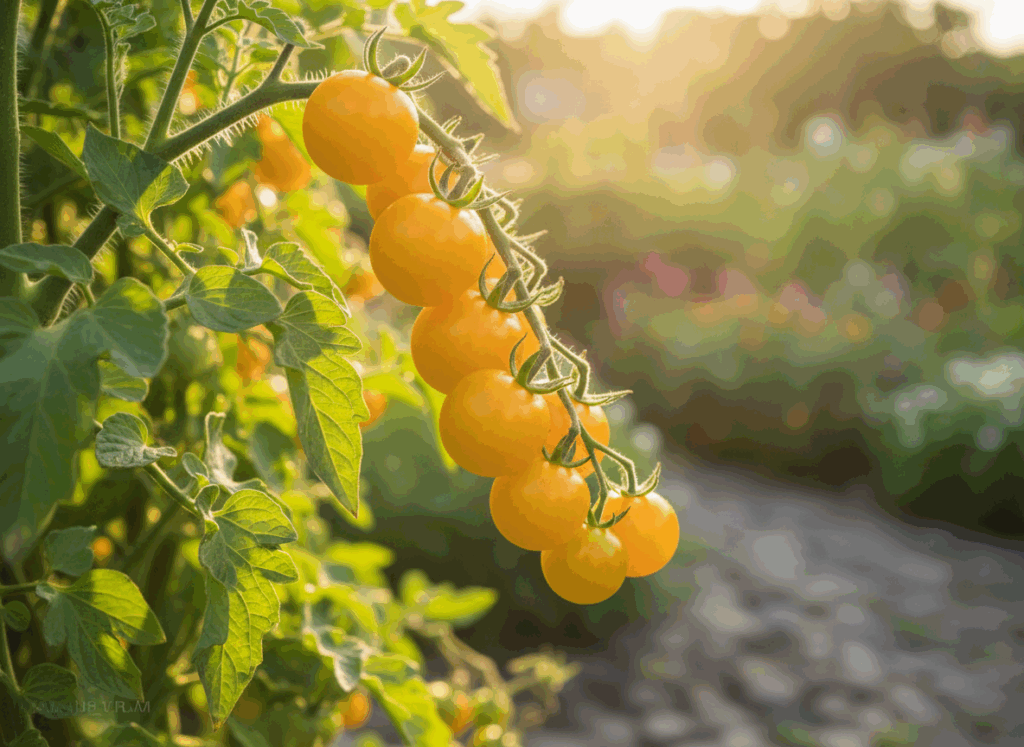
Its golden colour made it unforgettable, a small sun among the red multitudes. Its flavour made it beloved, sweet and complex, with whispers of honey and distant tropical shores. Its productivity made it practical, as it was reliable, generous, and steadfast through the seasons. Its ability to thrive in Central European climates made it dependable, a friend you could count on year after year.
Generation after generation, gardeners saved seed from their best plants. They selected for the most luminous gold, the sweetest taste, the most abundant harvest. Through this patient and devoted work, this quiet conversation between human hands and plant life has made Blondköpfchen what it is today: stable, distinctive, precious.
The name itself is a love letter. Blondköpfchen: little blonde head. This is not the cold designation of a scientist or the calculated branding of a seed company. This is a gardener’s name, spoken with affection, given to a plant that had earned personality, that had become more than a crop. It is the name you give to something small and golden and beloved.
A Journey Beyond Borders
For centuries, Blondköpfchen remained a secret of German-speaking gardens. It grew in home plots and market gardens, in the small, carefully tended spaces where European families cultivated the varieties they loved and refused to abandon. It was preserved by those who understood its value, who saved seed year after year, who would not let it disappear into the hungry mouth of time.
But seeds, like stories, have a way of travelling.
In the 20th century, as industrial agriculture threatened to erase centuries of careful cultivation, a movement emerged. Gardeners began seeking out old varieties, rescuing them from obscurity, preserving them with the same devotion their ancestors had shown. Heirloom seed companies became archivists of living history.
Blondköpfchen began to travel. Slowly, carefully, it moved beyond its Central European homeland. It appeared in catalogues. It found its way into the hands of gardeners who valued the unusual, the distinctive, the historically significant. By the late 20th century, it had crossed borders and oceans, carried by those who recognized that some treasures are worth sharing.
Finding Home in Northern Soil
By the 1980s and 1990s, Blondköpfchen arrived in Canada. It was brought by heirloom gardeners and specialty seed companies who understood that Canadian soil could nurture European heritage. The timing was perfect. This was the era when Canadian gardeners were rediscovering heirloom varieties, when people were learning that tomatoes could be more than uniform red spheres, when the desire for something different, something with history, something with soul, was taking root.
Blondköpfchen thrived in its new home.
Its compact size suited Canadian gardens, where space is often precious. Its golden colour sparked conversations over garden fences. Its European heritage appealed to those who valued tradition and the long memory of seeds. Its reliable productivity made it practical, even in shorter growing seasons.
By the 2000s and 2010s, Blondköpfchen had become established among Canadian heirloom gardeners. It was particularly adored by those who sought the unusual, who wanted to grow something that carried centuries in its cells, who understood that planting a seed could be an act of preservation and defiance against forgetting.
Planting History, Growing Beauty
When you plant Blondköpfchen today, you are not simply growing a tomato.
You are planting a seed that has travelled through centuries of European gardens, been carried across the Atlantic, and found a home in Canadian soil. You are growing a variety that has been saved, season after season, by gardeners who refused to let beauty and flavour disappear. You are participating in a conversation that spans generations. It is a dialogue between past and present, between European tradition and Canadian innovation, between those who came before and those who will come after.
You are planting history.
You are planting beauty.
You are planting a living connection to the gardeners who first whispered little blonde head and meant it as an endearment.
And when the first golden fruit appears on your plant, glowing like a small sun in the summer garden, you will understand why they loved it enough to save it. Why did they pass it down? Why it traveled so far to reach your hands.
Some things are worth preserving. Some beauty refuses to fade. Some stories, planted in soil, grow golden and sweet and true.
Learn more about growing Blondkopfchen Tomatoes in your garden: