
How an ancient Maya treasure, cultivated for thousands of years in volcanic mountains, crossed borders to become a symbol of indigenous agricultural wisdom in northern soil
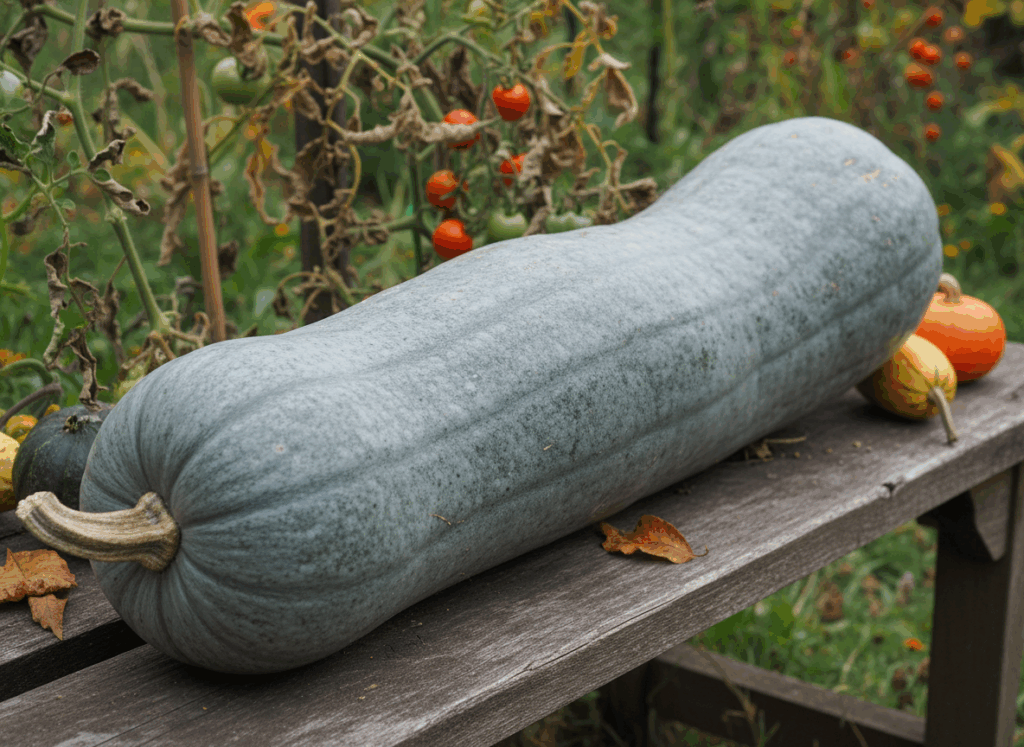
The Blue Giant of the Highlands
In the misty highlands of Guatemala, where volcanic peaks pierce clouds and terraced gardens cling to mountainsides, there grows a squash unlike any other. Guatemalan Blue Squash—also known as Guatemalan Blue Banana Squash—is one of the most breathtaking and historically profound winter squash varieties in existence. Its enormous, elongated fruits (15-30+ pounds) wear striking slate-blue skin that seems to hold the colour of highland skies. Inside, thick orange flesh as sweet as honey promises months of nourishment from a single harvest.
This is the giant of the squash world, the variety that produces harvests measured not in numbers but in pounds, that feeds families through entire winters, that connects modern gardeners across time and distance to Maya agricultural wisdom spanning millennia.
Born in Ancient Hands
The story of Guatemalan Blue reaches back over 10,000 years to ancient Mesoamerica, where indigenous peoples domesticated squash alongside corn and beans as part of the sacred “Three Sisters” agricultural system that sustained empires.
In the volcanic highlands of Guatemala, Maya farmers terraced mountainsides and coaxed abundance from challenging terrain. They understood what their communities needed to survive: squash that could produce enormous fruits, a single specimen capable of feeding a family for days or even weeks. Squash with exceptional storage quality, lasting months in the cool mountain air, bridging harvests and lean seasons. Squash with thick, sweet flesh rich in nutrients and calories, essential for survival in a world without refrigeration or grocery stores.
For thousands of years, Guatemalan Blue remained a treasure of the highlands. It was saved and passed down through generations, adapted to the specific conditions of Guatemala’s mountains. Countless hands shaped the variety, countless seasons, countless decisions about which fruits produced the best seeds.
This is not just a vegetable. This is a living library of agricultural knowledge. This is the accumulated wisdom of Maya farmers who understood soil, climate, nutrition, and the art of feeding communities with limited resources.
The Centuries of Continuity
While empires rose and fell, Spanish explorers arrived, and colonial powers reshaped the landscape. At the same time, the modern world transformed agriculture beyond recognition, but Guatemalan Blue continued to grow in highland gardens. Maya families continued to plant it, harvest it, cure it, and store it through long seasons. They continued to save seeds from the best fruits, carrying on the selection work their ancestors had begun thousands of years earlier.
This continuity is extraordinary. In a world where most traditional varieties have been lost, replaced by modern hybrids and industrial agriculture, Guatemalan Blue survived because it was essential. It was not a curiosity. It was not a novelty. It was food, sustenance, survival.
The variety remained largely unknown outside Guatemala and Maya communities. It was not listed in seed catalogues. It was not featured in agricultural journals. It simply existed, quietly, in the hands of the people who had consistently grown it.
The Rediscovery
Then came the late 20th century and a shift in consciousness.
Seed savers, heirloom enthusiasts, and agricultural researchers began seeking out traditional varieties from indigenous communities around the world. They recognized what had been lost in the rush toward modern agriculture: genetic diversity, adaptation to specific environments, exceptional flavour and nutrition, and cultural heritage that cannot be recreated in a laboratory.
Guatemalan Blue was “rediscovered” by North American gardeners in the 1980s and 1990s. They travelled to Guatemala, connected with Maya farmers, requested seeds, and carried them north across borders.
When North American gardeners first grew Guatemalan Blue, they were immediately captivated.
Honoring Indigenous Wisdom
The rediscovery of Guatemalan Blue represents a broader movement to honour, preserve, and celebrate indigenous agricultural wisdom.
For too long, modern agriculture dismissed traditional varieties as “primitive” or “inferior” to modern hybrids. But gardeners and seed savers recognized what indigenous farmers had always known: these varieties represent irreplaceable genetic diversity, adaptation to specific environments, exceptional flavour and nutrition, and cultural heritage that cannot be recreated in a laboratory.
Guatemalan Blue is not just a squash. It’s a testament to Maya ingenuity. It’s a living connection to ancient civilizations. It’s a reminder that the best plant breeding often happens over thousands of years in the hands of farmers who depend on their crops for survival.
When North American seed savers began growing and distributing Guatemalan Blue, they did so with reverence. They acknowledged its origins. They honoured the Maya farmers who had preserved it. They committed to keeping it alive, to sharing it generously, to ensuring that this ancient variety would not be lost.
Crossing the Border North
Guatemalan Blue Squash made its way to Canada through the networks of seed savers and heirloom enthusiasts who understood that borders are human constructs but seeds belong to everyone. Canadian gardeners, always eager for varieties that could store through long winters, recognized immediately that Guatemalan Blue was exactly what they needed.
Here was a squash bred for storage, for surviving months in cool conditions, for feeding families when fresh vegetables were distant memories. Here was a squash that understood scarcity, selected for thousands of years to bridge lean seasons.
Canadian gardeners planted Guatemalan Blue in their warmest, longest-season gardens. They gave the vigorous vines room to sprawl 10, 15, even 20 feet of summer growth. They watched as enormous blue-grey fruits developed, swelling through July and August, maturing in September and October.
The variety thrives in Canadian summers despite requiring our longest growing seasons. The extended daylight hours of northern latitudes compensate for cooler temperatures. The cool nights of late summer improve flavour and storage quality, just as they do in the highland nights of Guatemala.
A Living Connection
When you plant Guatemalan Blue Squash seeds in your Canadian garden, you are planting more than a vegetable. You are planting 10,000 years of Maya agricultural knowledge. You are planting the work of countless farmers who selected, saved, and refined this variety in the volcanic highlands of Guatemala.
You are planting the continuity of indigenous farming traditions that survived conquest, colonization, and modernization.
You are planting the efforts of seed savers who recognized the value of traditional varieties and worked to preserve them.
You are planting the practical wisdom of Canadian gardeners who understood that Guatemalan Blue was perfect for northern winters.
This is Guatemalan Blue. This is a Maya treasure, now growing in Canadian soil. This is the blue giant of the highlands, now thriving in northern gardens. This is the squash that reminds us that the best varieties are not created in laboratories—they are created over thousands of years by farmers who depend on their crops for survival.
This is our heritage. This is our connection. This is the squash that teaches us the meaning of abundance, storage, and the profound satisfaction of growing food that sustains.